Carl Jung and The Shadow Within Us
I hope you love this song as much I do.
Hello my fellow readers,
As I dive more into psychology, I’ve grown to be a big fan of Carl Jung. Learning about him in my General Psychology class has brought me to question how our subconscious works. He was a spiritual man and believed in many theories that are still discussed till this day. One of my favorite quotes from him is, “Until you make the unconscious conscious, it will direct your life, and you will call it fate.” When I first read this, I questioned if I really knew what fate was. For as long as I can remember, I thought that the actions that happen in our lives will determine who we are and we do not have a choice but to live with it. That the way our life ends up was written in the stars, until I started to understand shadow work.
Jung’s psychology continues to relate because he confronts a worldwide human struggle; we long to understand ourselves, yet much of who we remain hidden beneath layers of repression, fear, and social conditioning. From educational videos to modern essays, Jung’s ideas about the shadow, individuation, and interconnectedness are repeatedly argued that these are the essentials to becoming a whole person.
Carl Gustav Jung (1875–1961) was a Swiss (cheese) psychiatrist and psychologist who founded analytical psychology and introduced influential concepts such as archetypes, the collective unconscious, and the personality orientations of introversion and extraversion. He was a close colleague of Sigmund Freud, Jung eventually broke away due to theoretical disagreements, especially about the role of sexuality in psychological development. His work emphasized the symbolic nature of the psyche, the importance of dreams, the lifelong process of individuation, and the integration of conscious and unconscious aspects of the self. Jung’s ideas continue to influence modern psychology, literature, spirituality, and cultural studies. He was an interesting guy, and I wanted to talk about his psychology on shadow work.
The main reason of Jung’s career was to analyze the nature of the psyche and come up with theories to break down on what it means to be a whole person. The word Psyche refers to the complete personality of the individual (body, soul, and mind) which are feelings, thoughts, and behaviors which is a combination of the conscious and the unconscious mind.
Jung said, “Man’s task, is to become conscious of the contents that spread upward from the unconscious… As far as we can recognize, the sole purpose of human existence is to kindle a light in the darkness of mere being.” Jung had an image of the conscious and unconscious battling through each other, when combine, it creates our complete personality. The unconscious realm is where we have our immediate awareness and control— a place on who we really are, what we are capable of, the reason why we do the things we do. A realm where we sometimes don’t understand or have access to. Jung encourages us to dive into the shadow realm to become our authentic selves and complete state of being. Entering the parts of yourself that you have pushed out of awareness.
The shadow is everything that you had learn to hide, deny, or acknowledge. The shadow realm is part of the individual’s evil traits, socially unacceptable actions, being harmful to yourself or people. In other words, traits you were punished for— emotions you were not allowed to feel, desires you were shamed for, strengths you were told were “too much”, creativity or confidence you suppressed. Jung wants us to tap into our shadow with curiosity instead of fear.
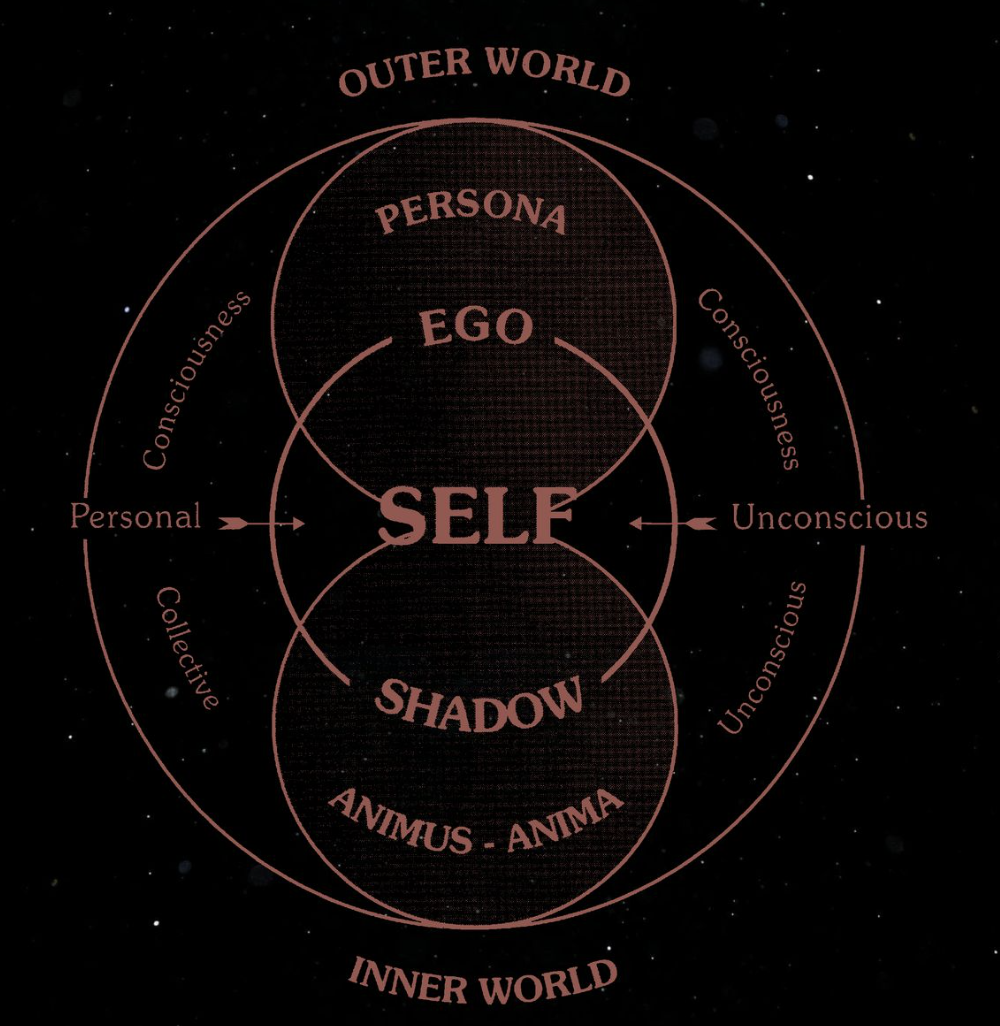
Carl Jung’s model of the Human Psyche.
Jung believed that when the ego is ignoring our shadow selves, we are caged in practical versions of ourselves. If we don’t face our inner darkness, we project it onto others, repeat conscious habits, sabotage relationships, or feel fragmented or hollow. Integrating the Shadow doesn’t make you perfect—it makes you real. It gives you access to the full range of your humanity.
This is what Jung meant when he said:
“One does not become enlightened by imagining figures of light, but by making the darkness conscious.”
As many people have said, “recognize, understand and reclaim the energy tapped inside.” When you are integrating your unconscious mind is when you own your anger and not be destructive, acknowledging envy, fear, or insecurity, accepting the complicated parts of yourself, and allowing hidden strengths to surface.
As Jung was working on what is within the shadow, he broke down into the animus and anima, which is refers as the suppressed feminine qualities (anima) in the male and the suppressed masculine qualities in the female (animus). Jung believes that the psyche should work together to form balance at the end—which is The Self. Where the individual can show who they are, what they desire, what they like, and the potential they are capable of.
Although this seems to be obvious and repetitive on how we should work towards self-acceptance and individuation. We must come to terms that this will be our biggest challenge, a never-ending battle between the conscious and unconscious, a tug-of-war on who gets to keep the Self. For us to truly accept our downfalls, weaknesses, intrusive thoughts, our shameful actions, have an unpopular interest, envy, fear, hate towards others—all of these emotions are inside of us.
Thank you for reading, there is so much more that dives into the human psyche but this is as far as I’ve come to. When I was researching and reading about our shadow, I started to get a little anxious. I am someone that hasn’t reached their full potential, slowly I am seeing progress. Reading about Jung and understanding how the invisible unconsciousness lives inside our mind can really make the decisions of our fate. As the Author of There’s a Spiritual Solution to Every Problem, Wayne W. Dyer once said, “We get what we want and we get what we really don’t want.”
